

TaleHug AI Story Generator for Kids
TaleHug transforms a child's voice, drawing, or idea into an instant AI-illustrated storybook for safe co-reading.
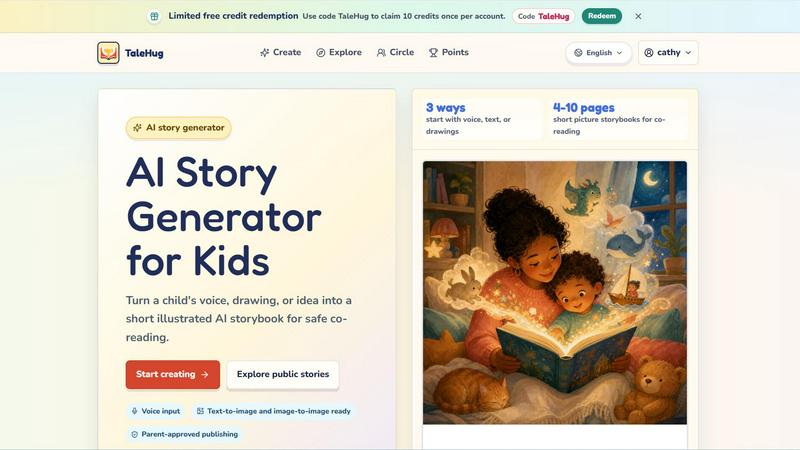
About TaleHug AI Story Generator for Kids
TaleHug is a revolutionary AI-powered storytelling platform engineered specifically for the next generation of creators. It transforms the raw, unfiltered imagination of a child into beautifully illustrated, co-readable storybooks in seconds. This is not merely a digital toy; it is a portal to a future where every child can be an author, illustrator, and narrator of their own universe. By accepting inputs as diverse as a spoken voice, a hand-drawn sketch, or a simple text idea, the advanced AI engine generates a complete, multi-page picture storybook. The platform is meticulously designed for preschool and kindergarten-aged children (ages 3-6), with a safety-first architecture that prioritizes parent-guided creation and sharing. Every story begins as a private draft, and any move to the public sphere requires explicit adult approval, ensuring a secure and nurturing environment. TaleHug bridges the gap between a child's fleeting thought and a tangible, visual narrative, fostering literacy, creativity, and emotional intelligence. It is the definitive tool for modern families, progressive classrooms, and any adult seeking to unlock a child's storytelling potential through the safe, powerful lens of artificial intelligence. The interface is intuitive, vibrant, and built for co-reading, making it a seamless addition to bedtime routines, classroom activities, and creative play.
Features of TaleHug AI Story Generator for Kids
Multimodal Input Engine
This is the core innovation that sets TaleHug apart. The platform is not limited to text. A child can speak their story idea into the microphone, and the AI will parse the vocal narrative into a structured story. Alternatively, a child can draw a picture, upload it, and the AI will use image-to-image generation to create a storybook based on that visual. This feature eliminates the barrier of writing proficiency, allowing even pre-literate children to become storytellers. It captures the essence of a child's idea in its purest form, whether it is a sound, a scribble, or a sentence, and transmutes it into a polished, illustrated narrative.
AI-Powered Illustrated Storybook Generation
Once an idea is captured, the TaleHug AI engine goes to work, generating a complete picture storybook ranging from 4 to 10 pages. Each page is a perfect marriage of a high-quality, colorful illustration and a single, short, age-appropriate sentence. The AI stores the generation prompts for every page, granting the parent or child the power to regenerate any page for a different artistic style or narrative direction. This is not a static output; it is a dynamic, iterative creative process. The result is a professional-looking storybook that feels like it was crafted by a human illustrator, ready for co-reading and sharing.
Parent-Approved Publishing and Safety Architecture
TaleHug is built on a foundation of uncompromising safety and privacy. The entire creation process is designed for parent-guided sharing. All new story drafts are private by default, visible only to the creator and their linked parent account. Publishing a story to a "Circle" of family and friends or to the public gallery requires an explicit, one-time approval from the parent. The platform enforces strict data minimization: it uses safe display names instead of real child names, does not collect school names, addresses, or contact details, and the MVP has zero public comments. This creates a secure digital sandbox where creativity can flourish without risk.
Three Visibility Modes and Community Gallery
The platform offers a graduated system for sharing a child's creative work. The first mode is "Private," where the story exists only for the child and parent. The second is "Circle," which allows sharing with a curated group of family and friends, fostering positive reinforcement in a controlled environment. The third is "Public," which publishes the story to the TaleHug public gallery for the world to see, but only after parent approval. The public gallery itself is a curated space of approved examples, serving as a source of inspiration and a showcase for the incredible stories being created by young minds globally. This feature teaches digital citizenship and the joy of sharing creativity safely.
Use Cases of TaleHug AI Story Generator for Kids
Bedtime Story Creation
Parents can use TaleHug to transform a child's spoken desire for a specific bedtime story into a real, illustrated book in minutes. If a child says, "Tell me a story about a moon rabbit who is scared of the dark," the parent can use the voice input feature to capture this. The AI will generate a 4-10 page storybook with soothing illustrations and gentle narrative. This turns the nightly routine from passive consumption into an active, collaborative creation, making bedtime a magical, personalized experience that the child helped author.
Classroom Social and Emotional Learning
Teachers can leverage TaleHug to help children process complex social situations and emotions. For example, a teacher can use a pre-approved prompt like "Sharing the red truck" to generate a story about taking turns. Alternatively, a child who is feeling nervous about the first day of school can create a "First school morning" story. The AI generates a narrative that helps the child name and navigate their feelings. This provides a powerful, visual tool for social-emotional learning (SEL) that is more engaging and relatable than a standard worksheet.
Creative Writing and Literacy Development
For emerging readers and writers, TaleHug removes the friction of handwriting and spelling, allowing them to focus purely on narrative structure and imagination. A child can draw a picture of a "soldier and a star witch" and upload it. The AI will create a story based on that drawing, and the child can then read the generated text, learning new vocabulary and sentence structure. This use case is revolutionary for literacy development, as it provides immediate, high-quality feedback and a finished product that instills a sense of authorship and pride in the child.
Family Bonding and Co-Creation
TaleHug is designed for co-reading, making it a perfect tool for family bonding. A parent and child can sit together, brainstorm an idea, and watch as the AI brings their shared vision to life. They can then read the finished storybook together, discussing the pictures and the narrative. This collaborative process strengthens the parent-child relationship and creates a shared digital artifact that can be revisited and cherished. It turns screen time into a positive, interactive family activity that builds lasting memories.
Frequently Asked Questions
How does the voice input feature work for children who cannot read or write yet?
The voice input feature is designed to be the primary interface for pre-literate children. A child simply taps the microphone icon and speaks their story idea aloud. The advanced speech-to-text AI accurately transcribes the child's words, even with imperfect grammar or pronunciation, and uses that transcript as the core prompt for generating the storybook. This eliminates the need for any typing or writing skills, making the entire creation process accessible to toddlers and preschoolers.
Is my child's personal information safe on TaleHug?
Absolutely. TaleHug is architected with a "private by default" model. The platform does not require or store real child names, school names, addresses, or any contact details. It uses safe, user-chosen display names. All stories are created as private drafts. Any form of sharing, including publishing to a "Circle" or the public gallery, requires explicit parent approval. Furthermore, the MVP has zero public comments, preventing any form of public interaction or feedback from strangers.
Can we regenerate a page if we do not like the illustration or text?
Yes, this is a core feature of the creation engine. Every generated page stores the underlying AI prompt that was used to create it. If a child or parent is not satisfied with an illustration, they can simply click a button to regenerate that specific page. The AI will create a new variation of the image and text based on the same prompt. This allows for endless creative iteration and ensures the final storybook perfectly matches the creator's vision.
What is the difference between the "Private," "Circle," and "Public" visibility settings?
"Private" means the story is visible only to the child creator and their linked parent account. "Circle" allows the story to be shared with a curated, pre-approved list of family and friends, fostering positive feedback in a safe environment. "Public" publishes the story to the TaleHug public gallery for all users to see and be inspired by. Crucially, any transition from Private to Circle or Public requires a parent to explicitly approve and publish the story, ensuring no child content goes live without adult supervision.
Explore more in this category:
Similar to TaleHug AI Story Generator for Kids

Screen Issues
Free Online Screen Test Tool - Instantly diagnose dead pixels, lines, color issues, and flickering. Multiple test modes, no download needed.

SQLCrab
SQLCrab is a website where you can practice SQL database queries right in your web browser. It uses a real Postgres database engine so you can learn.

Verla AI
Verla is an AI academic assistant for university and college students, combining AI essay writing, academic research, AI detection, AI humanization


Explainer Video
AI Explainer Video Generator that turns topics, scripts, URLs, and PDFs into clear animated videos with AI-built storyboards, visuals, voiceovers, and

Delta Report
Free, Live 3D Satellite, Space Weather & Climate Tracker in real time on an interactive globe alongside articles and insights.

The French Corner
Learn French through visual stories told by a native speaker. Words you meet come back on their own, right before you'd forget them.
