
Deeploy vs iGPT
Side-by-side comparison to help you choose the right AI tool.

Deeploy
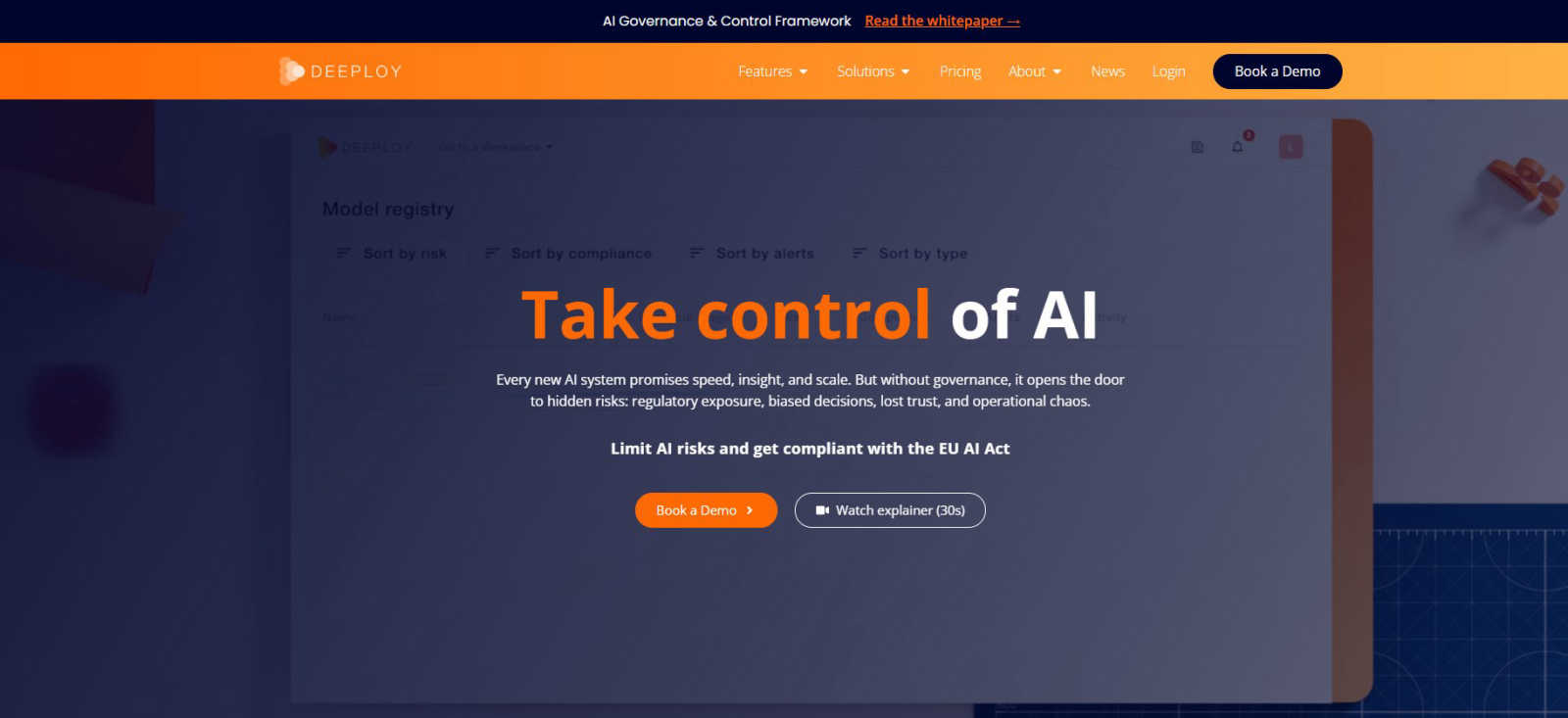
Deeploy governs and scales your AI with complete oversight and control.
Last updated: February 28, 2026

iGPT is the enterprise API that transforms messy email data into trusted, context-aware answers for AI agents.
Last updated: February 28, 2026
Visual Comparison
Deeploy
iGPT
Feature Comparison
Deeploy
AI Discovery and Onboarding
Deeploy provides complete visibility across your entire AI landscape, eliminating dangerous blind spots. It allows you to discover, onboard, and manage every AI system in your organization from a single, unified interface. The platform connects seamlessly to any MLOps or GenAI platform, enabling centralized control and oversight without the need for costly and disruptive migration projects. This foundational feature creates a living, centralized inventory, turning AI chaos into a mapped and manageable portfolio.
Control Frameworks
Navigate the complex web of AI regulations with confidence using Deeploy's guided control frameworks. The platform offers default frameworks aligned with major standards like ISO 42001 and the NIST AI RMF, or allows you to build custom ones tailored to your specific needs. This system enables you to classify AI system risk levels in minutes and establish clear accountability with structured approval processes. It transforms abstract compliance requirements into straightforward, executable workflows.
Control Implementation
Deeploy turns governance frameworks into enforceable, engineer-friendly controls. It automatically assigns the right requirements to every AI system without manual intervention, giving technical teams clear and actionable tasks. The platform accelerates compliance by up to 90% through the use of intelligent templates and automated evidence collection. It even leverages AI-powered assessments to handle repetitive governance work, ensuring policies are actually followed and implemented.
Real-Time Monitoring and Explainability
Prevent AI incidents before they happen with Deeploy's predictive monitoring suite. The system provides instant alerts for critical issues like model drift, performance degradation, or output anomalies, often identifying problems before end-users are impacted. It adds essential tracing and guardrails to protect LLM outputs and ensures full auditability. Combined with built-in explainability features, it provides transparency into model decisions, building trust and enabling continuous improvement.
iGPT
Unified Intelligence Endpoint
iGPT replaces entire multi-endpoint retrieval architectures with a single, powerful API call. Developers simply send a natural language query, and iGPT's integrated pipeline handles retrieval, sophisticated context shaping, and reasoning in one seamless operation. This eliminates the need to manage separate systems for parsing, vector stores, and prompt chains, dramatically accelerating development and reducing operational complexity for AI agents.
Autonomous Context Engineering
The platform autonomously handles the entire complex lifecycle of email intelligence. It performs real-time ingestion and deep indexing of messages and attachments, automatically reconstructs fragmented email threads across time and participants, and employs a hybrid retrieval system that combines semantic, keyword, and filter-based search. It then optimally shapes the context window for your LLM, delivering perfectly formatted, cited answers without any manual prompt tuning or maintenance.
Enterprise-Grade Security Fabric
iGPT is built with a zero-trust security architecture from the ground up. It enforces OAuth-only processing with strict Role-Based Access Control (RBAC) for every request and adheres to a rigorous zero-data-retention policy, where all inferences are processed in memory and never stored. Your data is never used to train models, ensuring full data sovereignty and providing a complete, immutable audit trail for all agentic actions.
Deep Attachment and Thread Intelligence
Beyond simple text, iGPT deeply processes all attachments—extracting text, data, and structure from documents, PDFs, and spreadsheets—and intelligently contextualizes this information within the email thread. It automatically rebuilds complete conversation threads, understanding relationships across time, participants, and attached files, turning disparate data points into a coherent, actionable narrative.
Use Cases
Deeploy
Enterprise-Wide AI Governance and Compliance
Large organizations deploying AI across multiple departments use Deeploy to establish a single source of truth for all AI assets. This central command center enables Chief AI Officers and compliance teams to maintain an inventory, enforce standardized risk assessment protocols, and automatically generate the documentation needed to prove adherence to regulations like the EU AI Act, transforming a manual, high-risk process into an automated, reliable system.
Scaling MLOps with Guardrails
AI and data science teams leverage Deeploy to scale their model deployment velocity safely. The platform integrates into existing MLOps pipelines, providing the essential governance layer that ensures every deployed model meets organizational standards for fairness, performance, and security. It reduces deployment time from weeks to hours while providing the observability and explainability needed for both technical and non-technical stakeholders.
Governing Generative AI Applications
Companies building customer-facing applications with large language models (LLMs) use Deeploy to implement critical guardrails. The platform monitors LLM outputs in real-time for hallucinations, toxicity, or data leakage, triggering alerts and interventions. It provides the tracing and audit trails necessary to understand why an AI made a specific decision, which is crucial for high-stakes industries like healthcare, finance, and legal services.
Managing Vendor and Embedded AI Risk
For businesses utilizing third-party AI APIs or embedded AI within purchased software, Deeploy acts as a risk management hub. It allows organizations to discover and onboard these external AI systems into their governance framework, assessing their risk classification and ensuring they are monitored for performance and compliance. This eliminates a major blind spot in modern enterprise AI strategy.
iGPT
Autonomous Email Assistants
Build next-generation AI agents that can draft, prioritize, summarize, and act on email with full, cited context. These assistants understand nuanced requests, manage inboxes proactively, and execute follow-up actions based on the complete history of a conversation and its attachments, moving beyond simple drafting to true email orchestration.
Intelligent Workflow Automation
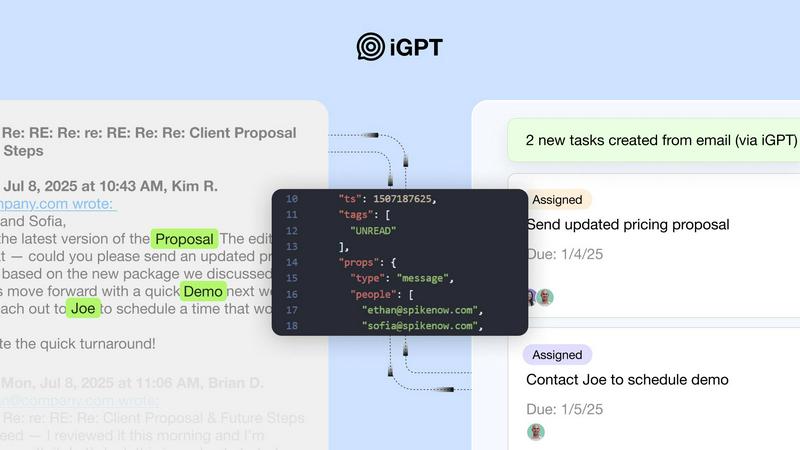
Transform unstructured email threads into structured, automated workflows. iGPT can automatically extract tasks, deadlines, approvals, and ownership details from conversations, flag stalled items, and feed this structured data into project management tools, CRMs, or ERP systems, turning communication into direct action.
Customer Support Copilots
Empower support teams with agents that instantly rebuild the entire customer story. By analyzing long, complex email chains, tone shifts, and all related attachments, iGPT provides support copilots with a complete historical context, enabling faster, more accurate resolutions and superior customer experiences.
Compliance and Audit Intelligence
Automate the tracing of feedback, approvals, decisions, and contractual rationale directly back to their source in original email conversations and attachments. iGPT creates a reliable, queryable audit trail, streamlining compliance processes, e-discovery, and internal reviews with agentic efficiency.
Overview
About Deeploy
Deeploy is the foundational command center for the AI-native enterprise, transforming chaotic AI sprawl into a governed, compliant, and trusted ecosystem. It serves as the essential governance infrastructure layer, providing complete oversight, compliance, and real-time monitoring for every AI system across an organization. Designed for forward-thinking companies scaling AI across diverse models, vendors, and embedded systems, Deeploy eliminates critical blind spots by centralizing control without forcing disruptive migrations or platform changes. Its core value proposition is enabling organizations to accelerate AI innovation and deployment exponentially while simultaneously mitigating risk, ensuring regulatory adherence to frameworks like the EU AI Act, and building immutable trust. By offering flexible onboarding, actionable control frameworks, and predictive monitoring, Deeploy moves governance from a reactive, manual burden to a proactive, automated force multiplier. This allows businesses to harness AI's transformative power with absolute confidence and complete control, turning governance into a strategic accelerator rather than a bottleneck.
About iGPT
iGPT is the foundational intelligence layer for the agentic future, engineered to transform the world's most critical but chaotic communication medium—email—into structured, actionable, and trusted context. It is an enterprise-grade API that serves as a secure and auditable gateway, enabling AI agents and automated workflows to seamlessly access, comprehend, and leverage the vast intelligence trapped within sprawling email conversations and complex attachments. Built for developers and enterprises, iGPT surgically eliminates the traditional AI breakdown point: the immense complexity of parsing, chunking, indexing, and endless prompt-tuning required to make sense of messy, threaded, and document-rich email data. Its revolutionary core value proposition is a single, unified API call that delivers cited, context-aware answers in seconds, completely replacing fragile, multi-step retrieval pipelines. With end-to-end security, granular RBAC, and a strict zero-data-retention policy, iGPT empowers organizations to deploy autonomous agents with absolute confidence, ensuring compliance, maintaining data sovereignty, and unlocking unprecedented operational intelligence from the platform where real work actually happens.
Frequently Asked Questions
Deeploy FAQ
How does Deeploy handle existing AI systems without causing disruption?
Deeploy is designed as a non-invasive governance layer. It does not require you to migrate your AI models or change your existing MLOps platforms. Instead, it uses flexible connectors and discovery tools to integrate with your current stack, pulling metadata and establishing oversight without interfering with live systems. This allows you to centralize control and gain visibility without operational downtime or re-engineering costs.
Can Deeploy help us comply with the EU AI Act and other regulations?
Absolutely. Deeploy is built with evolving global regulations like the EU AI Act as a first-class concern. It provides pre-built control frameworks mapped to these standards, guiding you through risk classification, documentation requirements, and monitoring obligations. The platform automates evidence collection and generates audit-ready reports, significantly reducing the manual burden of proving compliance and adapting to new regulatory demands.
What kind of monitoring and alerts does Deeploy provide?
Deeploy offers predictive, real-time monitoring that tracks key performance indicators, data drift, concept drift, and output anomalies for all your AI systems. It provides instant, configurable alerts when metrics deviate from expected baselines or when potential compliance violations are detected. For generative AI, it includes specialized monitoring for output quality, toxicity, and hallucination rates, allowing you to intervene before issues affect users.
Is Deeploy suitable for governing both traditional machine learning and generative AI?
Yes, Deeploy is architected as a universal governance platform for the entire AI spectrum. It provides tailored oversight for traditional ML models, including performance tracking and explainability, and specialized frameworks for generative AI applications, including prompt management, output guardrails, and LLM-specific risk assessments. This unified approach prevents governance silos and provides comprehensive oversight across all AI modalities.
iGPT FAQ
How does iGPT differ from using a generic LLM API on email text?
While a generic LLM can process text, iGPT is a complete intelligence pipeline specifically engineered for email's unique chaos. It handles the entire stack: real-time ingestion, deep attachment parsing, automatic thread reconstruction, hybrid retrieval, and optimized context shaping—all through one API call. You avoid the months of engineering work required to parse, chunk, index, and prompt-tune a system capable of understanding real-world email data with citations.
What is the Context Engineering Framework (CEF)?
The Context Engineering Framework (CEF) is iGPT's proprietary, tiered system for optimizing the intelligence retrieval process. It allows developers to select different quality and speed profiles (like cef-1-normal) for their queries, balancing factors such as retrieval depth, reasoning complexity, and latency to match the specific needs of their agentic application, all without manual tuning.
How does iGPT ensure the security of my company's email data?
Security is foundational. iGPT employs OAuth-only authentication with granular Role-Based Access Control (RBAC), ensuring users and agents can only access data they are explicitly permitted to see. It operates on a strict zero-data-retention policy—all data is processed in memory for a single inference and is never stored or logged. Furthermore, your data is never used to train or improve any models.
Can iGPT connect to and index email data in real-time?
Yes. iGPT provides seamless integration methods to connect to your organization's email sources. Once connected, it performs continuous, real-time indexing, ensuring that the intelligence it provides is always based on the most up-to-date inbox state, attachments, and conversations, enabling agents to act on live information.
Alternatives
Deeploy Alternatives
Deeploy is the foundational command center for governing and scaling AI, a critical layer of infrastructure for the AI-native enterprise. It transforms chaotic AI sprawl into a governed, compliant, and trusted ecosystem, providing complete oversight and real-time monitoring across all models and vendors. Organizations may explore alternatives for various strategic reasons, such as aligning with specific budget constraints, requiring different feature integrations, or needing a platform tailored to a unique operational stack. The search often stems from a need to balance comprehensive governance with flexible deployment options. When evaluating an alternative, prioritize solutions that offer predictive, automated oversight rather than manual, reactive checks. Look for a platform that serves as a proactive force multiplier, enabling exponential AI innovation while ensuring immutable trust and adherence to evolving regulatory frameworks like the EU AI Act.
iGPT Alternatives
iGPT is an enterprise-grade API that serves as a foundational intelligence layer, transforming chaotic email data into structured, context-aware answers for AI agents. It belongs to the business intelligence category, specifically designed to solve the complex problem of making unstructured email communications actionable for autonomous systems. Users may explore alternatives for various reasons, including specific budget constraints, the need for different integration capabilities, or platform requirements that extend beyond email intelligence. The search often stems from a need to find the optimal fit for their unique technical stack and operational scale. When evaluating alternatives, prioritize solutions that offer robust, auditable security, genuine context-awareness beyond simple keyword search, and the ability to handle the inherent messiness of threaded conversations and attachments. The core value lies in eliminating multi-step data pipelines with a single, reliable API call that delivers trusted, cited intelligence.