
Fusedash vs iGPT
Side-by-side comparison to help you choose the right AI tool.

Fusedash transforms raw data into instant AI-powered dashboards for real-time team insights.
Last updated: March 4, 2026

iGPT is the enterprise API that transforms messy email data into trusted, context-aware answers for AI agents.
Last updated: February 28, 2026
Visual Comparison
Fusedash
iGPT
Feature Comparison
Fusedash
Unified Intelligent Workspace
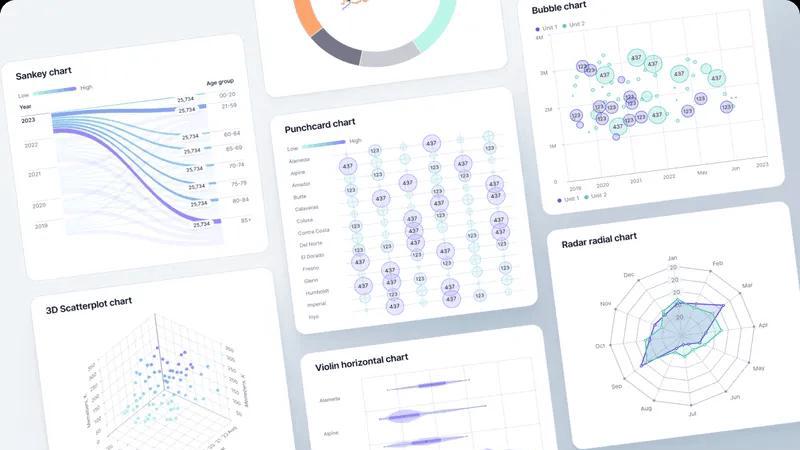
Fusedash consolidates the entire data visualization stack into a single, coherent environment. Gone are the days of juggling separate tools for dashboards, charts, maps, and reports. This singular workspace allows teams to build interactive dashboards for real-time monitoring, craft detailed narrative reports with storytelling sections, and generate standalone AI-powered charts—all from the same connected dataset. This architectural unity eliminates redundant work, ensures metric consistency, and provides a holistic view of performance, enabling a seamless flow from monitoring to deep analysis to communication.
AI-Powered Chart & Insight Generation
Harness the power of integrated artificial intelligence to accelerate data exploration. The platform's AI chart generator transforms raw CSVs or live API data into clear, actionable visuals within seconds. Beyond simple generation, the smart chat interface allows users to interrogate their data using natural language, asking complex questions to uncover hidden trends, receive intelligent suggestions for optimal visualizations, and instantly refine metrics. This feature democratizes advanced analytics, making deep data exploration accessible to every team member without requiring specialized technical expertise.
Consistent Metric Fabric & Reusable Logic
Fusedash introduces the concept of a "metric fabric"—a centralized layer where all key business definitions, calculations, and dimensions are established. Once a KPI like "North American User Growth" or "Customer Acquisition Cost" is defined, it becomes a reusable, immutable component across the entire platform. This ensures that every chart, dashboard, and report automatically reflects the same calculation, eradicating version conflicts and establishing a single, trusted source of truth that aligns every stakeholder, from leadership to operational teams.
Flexible, Multi-Modal Visualization Engine
The platform provides a revolutionary adaptive canvas that morphs to suit any analytical need. Transform your core dataset into an executive dashboard, a detailed geographical heatmap, a time-series chart for trend analysis, or a narrative-driven report with contextual commentary. This multi-modal capability allows you to build the perfect view for every audience without duplicating underlying data work. Customize layouts, apply dynamic filters, and enable drill-down capabilities to answer not just what happened, but where and why it happened.
iGPT
Unified Intelligence Endpoint
iGPT replaces entire multi-endpoint retrieval architectures with a single, powerful API call. Developers simply send a natural language query, and iGPT's integrated pipeline handles retrieval, sophisticated context shaping, and reasoning in one seamless operation. This eliminates the need to manage separate systems for parsing, vector stores, and prompt chains, dramatically accelerating development and reducing operational complexity for AI agents.
Autonomous Context Engineering
The platform autonomously handles the entire complex lifecycle of email intelligence. It performs real-time ingestion and deep indexing of messages and attachments, automatically reconstructs fragmented email threads across time and participants, and employs a hybrid retrieval system that combines semantic, keyword, and filter-based search. It then optimally shapes the context window for your LLM, delivering perfectly formatted, cited answers without any manual prompt tuning or maintenance.
Enterprise-Grade Security Fabric
iGPT is built with a zero-trust security architecture from the ground up. It enforces OAuth-only processing with strict Role-Based Access Control (RBAC) for every request and adheres to a rigorous zero-data-retention policy, where all inferences are processed in memory and never stored. Your data is never used to train models, ensuring full data sovereignty and providing a complete, immutable audit trail for all agentic actions.
Deep Attachment and Thread Intelligence
Beyond simple text, iGPT deeply processes all attachments—extracting text, data, and structure from documents, PDFs, and spreadsheets—and intelligently contextualizes this information within the email thread. It automatically rebuilds complete conversation threads, understanding relationships across time, participants, and attached files, turning disparate data points into a coherent, actionable narrative.
Use Cases
Fusedash
Executive Leadership & Strategic Reporting
Replace static, weekly PDF reports with a living, breathing executive command center. Leadership can access a unified dashboard showcasing top-level KPIs across all departments, with the ability to drill down instantly into specific segments or time periods using intuitive filters and AI chat. Combine high-level metrics with integrated storytelling reports that provide context on performance shifts, enabling faster, more informed strategic decisions based on a consistent data narrative.
Marketing Performance & Campaign Analytics
Marketing teams can consolidate data from multiple channels (social media APIs, ad platforms, CRM) into a single Fusedash workspace. Create real-time dashboards to monitor campaign ROI, generate AI-powered charts to visualize conversion trends by demographic, and build shareable reports that tell the story of a campaign's impact. The consistent metric fabric ensures that terms like "lead" or "conversion" are standardized, providing clear, unambiguous performance analysis.
Operational Monitoring & Real-Time Analytics
Operations and product teams can leverage Fusedash for live monitoring of key systems and user behaviors. Connect live APIs to create real-time interfaces that track application performance, feature adoption, or logistical metrics. Set up intelligent alerts and use the map visualization feature to monitor geographical distribution of events or assets. This enables proactive issue identification and rapid response based on a continuously updated data stream.
Cross-Functional Project & KPI Alignment
Eliminate departmental data silos by creating a shared Fusedash project space for key initiatives. Define project-specific KPIs once in the metric fabric, and allow each team—engineering, sales, support—to build their own tailored views (dashboards, charts) from the same core data. This ensures all teams are aligned on progress, priorities, and outcomes, fostering collaboration and ensuring everyone is working from an identical set of facts.
iGPT
Autonomous Email Assistants
Build next-generation AI agents that can draft, prioritize, summarize, and act on email with full, cited context. These assistants understand nuanced requests, manage inboxes proactively, and execute follow-up actions based on the complete history of a conversation and its attachments, moving beyond simple drafting to true email orchestration.
Intelligent Workflow Automation
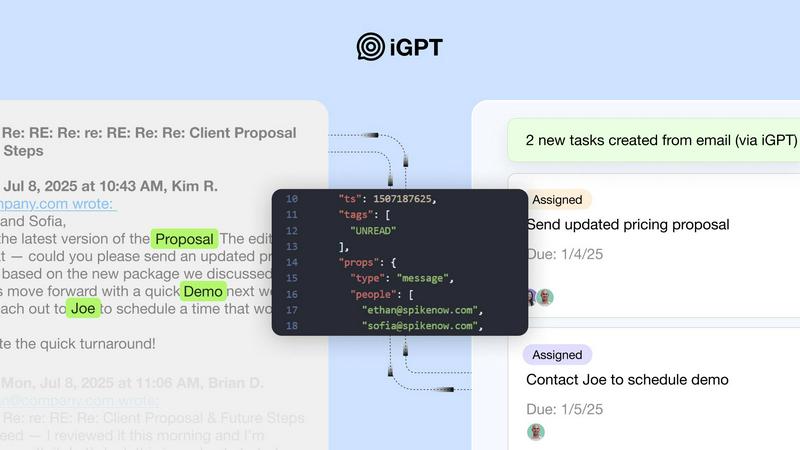
Transform unstructured email threads into structured, automated workflows. iGPT can automatically extract tasks, deadlines, approvals, and ownership details from conversations, flag stalled items, and feed this structured data into project management tools, CRMs, or ERP systems, turning communication into direct action.
Customer Support Copilots
Empower support teams with agents that instantly rebuild the entire customer story. By analyzing long, complex email chains, tone shifts, and all related attachments, iGPT provides support copilots with a complete historical context, enabling faster, more accurate resolutions and superior customer experiences.
Compliance and Audit Intelligence
Automate the tracing of feedback, approvals, decisions, and contractual rationale directly back to their source in original email conversations and attachments. iGPT creates a reliable, queryable audit trail, streamlining compliance processes, e-discovery, and internal reviews with agentic efficiency.
Overview
About Fusedash
Fusedash is the next-generation AI data visualization platform, engineered to dismantle the traditional barriers between data, insight, and action. It represents a paradigm shift from fragmented, manual reporting to a unified, intelligent workspace. This platform empowers forward-thinking teams to transcend static dashboards, transforming raw, connected data into a dynamic, interactive source of truth. By leveraging cutting-edge AI, Fusedash automates the entire analytical workflow—from intelligent chart generation via natural language prompts to smart metric suggestions and contextual storytelling. It is designed for organizations trapped in endless reporting cycles, where data silos breed conflicting narratives and decision latency. The core revolutionary value lies in its foundational principle of "define once, deploy everywhere." Teams establish their core KPIs and business logic a single time, and Fusedash propagates these consistent, trusted definitions across every dashboard, chart, map, and narrative report. This ensures absolute alignment from the C-suite to frontline operations, turning data into a cohesive, actionable intelligence fabric that drives unified strategy and accelerated outcomes.
About iGPT
iGPT is the foundational intelligence layer for the agentic future, engineered to transform the world's most critical but chaotic communication medium—email—into structured, actionable, and trusted context. It is an enterprise-grade API that serves as a secure and auditable gateway, enabling AI agents and automated workflows to seamlessly access, comprehend, and leverage the vast intelligence trapped within sprawling email conversations and complex attachments. Built for developers and enterprises, iGPT surgically eliminates the traditional AI breakdown point: the immense complexity of parsing, chunking, indexing, and endless prompt-tuning required to make sense of messy, threaded, and document-rich email data. Its revolutionary core value proposition is a single, unified API call that delivers cited, context-aware answers in seconds, completely replacing fragile, multi-step retrieval pipelines. With end-to-end security, granular RBAC, and a strict zero-data-retention policy, iGPT empowers organizations to deploy autonomous agents with absolute confidence, ensuring compliance, maintaining data sovereignty, and unlocking unprecedented operational intelligence from the platform where real work actually happens.
Frequently Asked Questions
Fusedash FAQ
How does Fusedash ensure data consistency across different reports?
Fusedash employs a foundational "metric fabric" architecture. When you first connect your data, you define your core business metrics, calculations, and dimensional logic in a centralized, managed layer. Every subsequent dashboard, chart, map, or report built in the platform automatically pulls from these standardized definitions. This means a KI like "Monthly Recurring Revenue" is calculated identically everywhere, guaranteeing that all teams and stakeholders are viewing and acting upon the same verified numbers, eliminating conflicts and confusion.
What types of data sources can I connect to Fusedash?
The platform is built for a hybrid data environment. You can seamlessly upload static CSV files for one-time analyses or historical reporting. For dynamic, live data, Fusedash can connect directly to a wide array of business APIs from tools like Salesforce, Google Analytics, and ad platforms. Furthermore, it allows for the combination of multiple datasets (e.g., merging internal sales data with public demographic data) within a single view, creating rich, contextual insights without requiring external data preparation.
Can non-technical team members use the AI features effectively?
Absolutely. Fusedash is designed with an AI-native interface that prioritizes accessibility. The natural language chat feature allows any user to ask questions like "What were our top-selling products last quarter by region?" in plain English. The AI interprets the query, analyzes the connected data, and can suggest the correct chart type or even generate a complete visualization automatically. This lowers the barrier to entry, empowering business analysts, marketers, and managers to conduct deep data exploration without writing a single line of code or complex query.
How does the storytelling feature differ from a standard dashboard?
While dashboards excel at displaying real-time metrics and KPIs, they often lack narrative context. Fusedash's storytelling feature allows you to embed interactive charts and data tables within a narrative report format. You can add text commentary, annotations, and headers to explain why a metric changed, highlight key takeaways, and propose next steps. This transforms raw data into a persuasive, communicative document perfect for board reports, stakeholder updates, or strategic reviews, ensuring insights lead to clear understanding and action.
iGPT FAQ
How does iGPT differ from using a generic LLM API on email text?
While a generic LLM can process text, iGPT is a complete intelligence pipeline specifically engineered for email's unique chaos. It handles the entire stack: real-time ingestion, deep attachment parsing, automatic thread reconstruction, hybrid retrieval, and optimized context shaping—all through one API call. You avoid the months of engineering work required to parse, chunk, index, and prompt-tune a system capable of understanding real-world email data with citations.
What is the Context Engineering Framework (CEF)?
The Context Engineering Framework (CEF) is iGPT's proprietary, tiered system for optimizing the intelligence retrieval process. It allows developers to select different quality and speed profiles (like cef-1-normal) for their queries, balancing factors such as retrieval depth, reasoning complexity, and latency to match the specific needs of their agentic application, all without manual tuning.
How does iGPT ensure the security of my company's email data?
Security is foundational. iGPT employs OAuth-only authentication with granular Role-Based Access Control (RBAC), ensuring users and agents can only access data they are explicitly permitted to see. It operates on a strict zero-data-retention policy—all data is processed in memory for a single inference and is never stored or logged. Furthermore, your data is never used to train or improve any models.
Can iGPT connect to and index email data in real-time?
Yes. iGPT provides seamless integration methods to connect to your organization's email sources. Once connected, it performs continuous, real-time indexing, ensuring that the intelligence it provides is always based on the most up-to-date inbox state, attachments, and conversations, enabling agents to act on live information.
Alternatives
Fusedash Alternatives
Fusedash is an AI-native data visualization platform, a leader in the next-generation business intelligence category. It transforms raw data into a unified workspace of interactive dashboards and narrative reports, establishing a single source of truth for entire organizations. Users explore alternatives for various reasons, including specific budget constraints, the need for deeper integrations with a unique tech stack, or requirements for highly specialized analytical functions not covered by a general platform. The search often stems from a need to fine-tune the balance between automated insight generation and granular control. When evaluating other platforms, prioritize solutions that offer true metric consistency, eliminate data silos, and leverage AI not as a gimmick but as a core engine for exploration and narrative. The goal is to transition from static reporting to a dynamic, intelligent data interface that accelerates organizational decision velocity.
iGPT Alternatives
iGPT is an enterprise-grade API that serves as a foundational intelligence layer, transforming chaotic email data into structured, context-aware answers for AI agents. It belongs to the business intelligence category, specifically designed to solve the complex problem of making unstructured email communications actionable for autonomous systems. Users may explore alternatives for various reasons, including specific budget constraints, the need for different integration capabilities, or platform requirements that extend beyond email intelligence. The search often stems from a need to find the optimal fit for their unique technical stack and operational scale. When evaluating alternatives, prioritize solutions that offer robust, auditable security, genuine context-awareness beyond simple keyword search, and the ability to handle the inherent messiness of threaded conversations and attachments. The core value lies in eliminating multi-step data pipelines with a single, reliable API call that delivers trusted, cited intelligence.