

act101
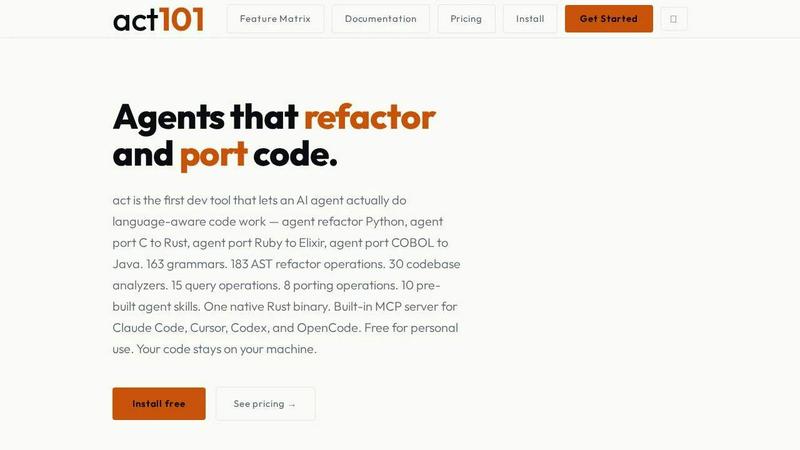
act101 is the first AI-native binary that lets coding agents surgically refactor and port code across 163 grammars with zero latency.
About act101
act101 is a revolutionary, AI-native dev tool that shatters the limitations of traditional coding assistants by giving AI agents the unprecedented ability to perform language-aware code refactoring and porting across an astonishing 163 programming languages. It is the first tool of its kind to bridge the gap between an AI agent's conversational capabilities and the precise, structural manipulation of source code. Built as a single, native Rust binary, act101 functions as a Model Context Protocol (MCP) server, integrating seamlessly with leading AI coding environments like Claude Code, Cursor, Codex, and OpenCode. Its core value proposition is enabling agents to execute complex, multi-file code transformations—such as extracting functions, renaming symbols across an entire workspace, or porting an entire C library to Rust—with AST-level accuracy, automatic checkpointing, and instant undo. This eliminates the "whole-file rewrite" problem, preserving comments, formatting, and developer intent. For engineers, architects, and teams facing the monumental tasks of modernizing legacy systems, migrating polyglot codebases, or simply enforcing high standards of code health, act101 is not just a tool; it is a paradigm shift, turning AI agents from passive advisors into active, reliable code surgeons. With 183 AST refactor operations, 30 codebase analyzers, 8 porting operations, and 10 pre-built agent skills, act101 operates with an average of ~85% fewer tokens than file-based operations, making it both incredibly efficient and secure, as your code stays entirely on your machine with no telemetry.
Features of act101
183 AST-Aware Refactor Operations
act101 empowers AI agents with a vast arsenal of 183 typed, Abstract Syntax Tree (AST)-aware refactoring operations. Unlike simple text replacements, these operations understand the syntax and semantics of the code, enabling precise actions like extract-function, rename-symbol, move-symbol, convert-to-dataclass, extract-trait, and inline. Each operation maintains cross-file consistency, automatically updating imports and references across the entire codebase. Every action is paired with an automatic checkpoint, giving the agent and the developer the power to instantly undo any change, ensuring a safe and iterative refactoring process.
8 Intelligent Code Porting Operations
This feature introduces a revolutionary state-machine-driven approach to cross-language migration. The agent can orchestrate an entire porting project by using operations like port_contract to define the migration's scope, port_inventory to catalog every symbol that needs to be moved, and port_order to resolve complex dependency chains. The port_manifest state machine (with states like init, add, update, remove, note) tracks progress step-by-step, ensuring a methodical and verifiable transformation from any of the 163 source grammars to any other target grammar, such as porting C to Rust or COBOL to Java.
30 Deep Codebase Analyzers
act101 provides agents with a powerful suite of 30 structural and quality analyzers that go far beyond simple linting. These analyzers can measure cohesion, coupling, detect cycles, find chokepoints and hotspots, identify dead code, and map module boundaries. They can also perform advanced analyses like migration readiness and type completeness. This gives the AI agent a complete, structural map of the repository before it makes a single change, allowing it to make informed decisions about where to refactor, what to port, and how to avoid introducing architectural debt.
10 Pre-Built Agent Skills for Complex Workflows
act101 bundles 10 pre-built, composable agent skills that turn its raw operations into high-level engineering workflows. A single command like /skill-name in Claude Code can invoke a complete architecture-audit, a thorough code-review, a targeted refactoring session, or a comprehensive migration-assessment. Other skills include boundary-analysis, change-impact, health-check, and architectural-refactoring. These skills orchestrate the underlying refactor, port, and analyze operations, allowing developers to delegate complex, multi-step tasks to the AI agent with confidence.
Use Cases of act101
Modernizing a Legacy COBOL Codebase to Java
A financial institution is burdened by a massive, mission-critical COBOL system. Using act101, an AI agent can initiate a migration-assessment skill to analyze the entire COBOL codebase, identifying the most critical modules and their dependencies. The agent then systematically uses the port_contract, port_inventory, and port_order operations to begin a methodical, step-by-step port to Java. Each translated module is verified for structural integrity, and the agent can refactor the new Java code for modern design patterns, all while maintaining a complete audit trail of the transformation.
Refactoring a Monolithic Python Web Application
A development team needs to break down a monolithic Python Django application into microservices. An agent using act101 can first run the boundary-analysis skill to identify natural seams and high-coupling areas within the codebase. Using the extract-function and move-symbol operations, the agent can safely extract independent modules, create new packages, and automatically update all internal imports across the project. The change-impact skill can then be used to verify that no other part of the application is broken by the refactoring, all with the safety of instant undo for each operation.
Cross-Language Code Review and Standardization
A company with a polyglot codebase (Python, TypeScript, Go, Rust) wants to enforce a consistent architectural pattern. An architect can instruct an agent to perform an architecture-audit skill across all four languages. The agent uses the 30 analyzers to measure coupling and detect architectural drift. It then uses language-specific refactoring operations, like convert-to-dataclass in Python or extract-trait in Rust, to align the code structures. The agent ensures that changes in one language's module don't break cross-language API contracts, providing a unified view of the system's health.
Automated Dependency Upgrade and Dead Code Removal
A team is upgrading a major library that has deprecated several APIs. An agent can use the health-check skill to scan the entire codebase for usages of the deprecated APIs. It then uses the rename-symbol and inline operations to replace deprecated calls with new ones across hundreds of files in seconds. Simultaneously, the dead code analyzer identifies functions and modules that are no longer called after the upgrade. The agent can then safely remove this dead code using remove-symbol operations, cleaning up the codebase and reducing maintenance burden.
Frequently Asked Questions
How does act101 ensure my code's safety during automated refactoring?
act101 is built with safety as a core principle. Every single refactor or port operation is executed with an automatic checkpoint. This means the AI agent can immediately undo any change, restoring the code to its previous state with a single command. Furthermore, because act101 operates on the AST rather than raw text, it preserves your code's formatting, comments, and logical structure, preventing the "whole-file rewrite" chaos common with other AI tools. Your code never leaves your machine, and there is no telemetry.
Can act101 work with my existing AI coding assistant?
Yes. act101 is a native Model Context Protocol (MCP) server, which is the emerging standard for connecting AI agents to external tools. It works out-of-the-box with Claude Code, Cursor, Codex, and OpenCode. By integrating act101 into your AI assistant's toolset, you grant it the ability to perform structured code operations that were previously impossible, transforming your assistant from a chat partner into a powerful, autonomous coding engineer.
What does it mean that act101 has 163 grammars?
act101 bundles the parsing and analysis logic for 163 different programming languages and file formats into a single, native Rust binary. This means it can understand the abstract syntax tree of almost any language you work with, from modern languages like Rust, Go, and TypeScript to legacy systems like COBOL and Fortran. This universal language support is the foundation for its cross-language porting capabilities and its ability to perform deep analysis on polyglot codebases.
Is act101 free to use, and what are the licensing terms?
act101 is completely free for personal use. This allows individual developers and hobbyists to experience the full power of AI-driven code transformation. For commercial and team use, there are paid licensing tiers that offer additional features like priority support, advanced security controls, and usage analytics. The license verification process may contact our servers, but the tool itself contains no telemetry, and your source code is never sent to an external server for processing.
Similar to act101

Sprite Sheet Maker
A free browser-based toolkit for creating, cutting, converting, and previewing sprite sheet animations.

Forms Plugin
The #1 Native Form Builder Plugin for Framer - No Code, No Embeds, No External Platforms.


TryKlingAI
Create Kling AI videos from text, images, audio, and motion references with Kling 3.0, Motion Control, Lip Sync, task tracking, and API access.


