
Blueberry vs Fallom
Side-by-side comparison to help you choose the right AI tool.

Blueberry
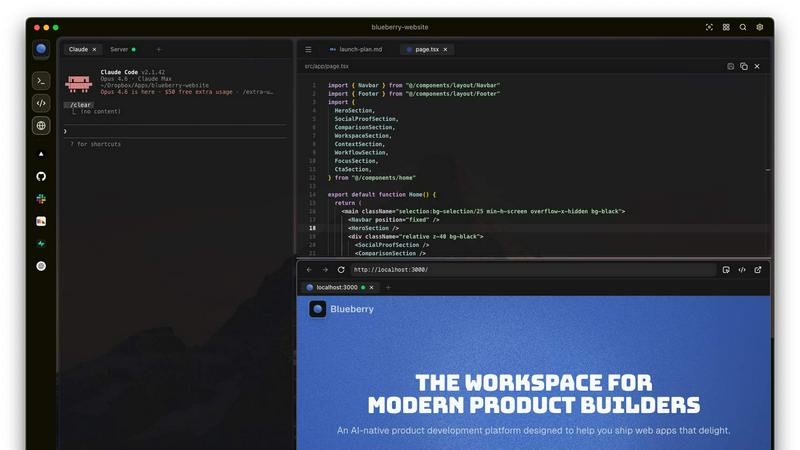
Blueberry is the AI-native workspace that unifies your editor, terminal, and browser for seamless product development.
Last updated: February 28, 2026

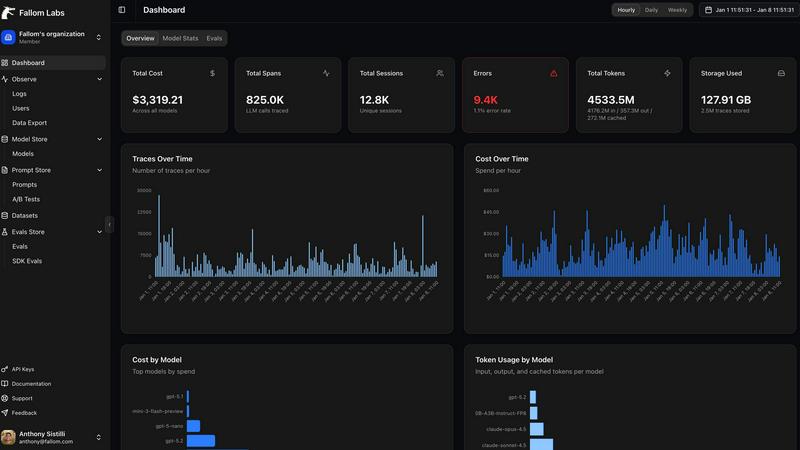
Fallom delivers real-time AI observability for every LLM call and agent.
Last updated: February 28, 2026
Visual Comparison
Blueberry
Fallom
Feature Comparison
Blueberry
Unified AI-Native Workspace
Blueberry deconstructs the traditional, siloed development workflow by fusing a powerful code editor, system terminal, and device-aware preview browser into one seamless interface. This triad operates not as separate apps but as interconnected panels within a single window, sharing state and context fluidly. The environment is built from the ground up to feed real-time data to integrated AI, creating a symbiotic workflow where your tools and your intelligence are perfectly aligned, eliminating friction and tab overload.
Full-Context AI via MCP Integration
The platform's groundbreaking integration with the Model Context Protocol (MCP) provides your chosen AI assistant with a live, comprehensive feed of your development state. Unlike basic chat plugins, Blueberry's built-in MCP server allows models to see your open files, real-time code changes, terminal commands and outputs, and even the visual state of your preview browser simultaneously. This constant, rich context enables the AI to offer precise, actionable guidance, debug with awareness, and generate code that fits perfectly into your running application.
Visual Context & Pinned Apps
Blueberry extends context beyond code to include your entire digital product ecosystem. The screenshot and direct element selection tool allows you to give your AI visual references from the preview browser. Furthermore, you can dock essential web apps like GitHub, Linear, Figma, and PostHog directly within the workspace. These "Pinned Apps" load with your project and share their live context with the AI, creating a holistic command center for product development.
Professional Editor with Git Integration
Despite its AI-centric design, Blueberry does not compromise on core developer tooling. It includes a fully-featured, professional code editor equipped with advanced syntax highlighting, multi-cursor support, robust find-and-replace, and built-in Git integration. This ensures you have all the power and precision of a modern editor, which simultaneously serves as the primary data source for your AI's deep understanding of the project structure and history.
Fallom
Real-Time LLM & Agent Tracing
Gain complete, real-time visibility into every interaction within your AI stack. Fallom captures and displays every LLM call, tool invocation, and reasoning step in a unified trace, providing granular data on inputs, outputs, token usage, latency, and cost. This enables instantaneous debugging of complex, multi-step agent workflows, allowing you to pinpoint failures, understand decision paths, and optimize performance with surgical precision.
Enterprise Cost Attribution & Governance
Achieve full financial transparency and control over your AI spend. Fallom automatically attributes costs down to the model, team, user, or customer level, enabling precise budgeting and chargebacks. Coupled with comprehensive audit trails, input/output logging, and model versioning, it provides the foundational data layer needed for compliance with stringent regulations like the EU AI Act, SOC 2, and GDPR.
Advanced Analytics & Model Operations
Move beyond basic metrics with powerful analytics built for AI. Conduct robust model A/B testing with live traffic splitting, run automated evaluations for accuracy and hallucinations, and version-control your prompts in a centralized Prompt Store. These capabilities allow you to scientifically improve quality, roll out new models confidently, and catch regressions before they impact users.
Privacy-First Architecture & Session Intelligence
Maintain full observability while protecting sensitive data. Fallom's Privacy Mode allows you to disable content capture or redact specific fields, ensuring compliance without sacrificing telemetry. Simultaneously, its session-tracking capability groups all traces by user, customer, or conversation, providing the holistic context needed to understand complete customer journeys and troubleshoot complex issues.
Use Cases
Blueberry
Rapid Full-Stack Web Development
Developers building modern web applications can leverage Blueberry to streamline the entire stack workflow. Write backend API logic in the editor, run and debug servers in the integrated terminal, and see frontend changes render instantly in the live preview browser—all while asking your AI to explain a complex route, generate a component based on the current UI, or diagnose a server error using the combined terminal and code context.
AI-Powered Debugging and Refactoring
When encountering bugs or planning a code refactor, use Blueberry's unified context to supercharge the process. Your AI can analyze the error output in the terminal, cross-reference it with the relevant code files open in the editor, and even inspect the broken UI state in the browser preview. This holistic view allows for accurate root-cause analysis and safe, context-aware suggestions for fixes and improvements.
Collaborative Design-to-Code Implementation
Designers and frontend developers working in tandem can use Blueberry to bridge the gap between design and implementation. Pin the Figma mockup in the workspace, use the browser's element selector to reference components, and instruct the AI to generate or adjust React/Vue code to match the design precisely, with immediate visual feedback in the multi-device preview pane.
Interactive Learning and Code Exploration
Students and developers exploring a new codebase or technology can use Blueberry as an interactive learning platform. Open a project, run it, and freely ask the AI questions about how specific files (like route.ts) work, request explanations of terminal commands, or get walkthroughs of the component hierarchy, with the AI guiding you through the actual, running code in real-time.
Fallom
Scaling Production AI Agents
Engineering teams use Fallom to transition AI prototypes into reliable, scalable production systems. By providing a real-time waterfall view of multi-step agentic workflows—including LLM calls, database queries, and API tool usage—teams can debug complex failures, optimize latency bottlenecks, and ensure their autonomous agents operate reliably at scale, delivering consistent user experiences.
Ensuring Regulatory Compliance & Auditability
Compliance officers and security teams leverage Fallom to meet rigorous regulatory requirements for AI systems. The platform generates immutable, detailed audit trails of every LLM interaction, including full prompt/response history, model versions, and user identifiers. This creates a verifiable chain of custody essential for audits, liability assessments, and adherence to frameworks like the EU AI Act.
Optimizing AI Spend & ROI
Product and finance leaders utilize Fallom's granular cost attribution to demystify AI expenditure. By tracking spend per project, feature, team, or end-customer, organizations can identify waste, justify budgets, implement chargebacks, and calculate precise ROI. This financial clarity is critical for managing AI as a scalable business utility rather than a black-box cost center.
Driving AI Product Excellence
Product managers employ Fallom's analytics suite to quantitatively improve AI features. They run A/B tests on different models or prompt versions, monitor evaluation scores for quality metrics like relevance and accuracy, and analyze user session traces to understand interaction patterns. This data-driven approach enables continuous iteration and delivery of superior AI-powered product experiences.
Overview
About Blueberry
Blueberry is the paradigm-shifting, AI-native product development platform engineered for the modern builder. It transcends the traditional, fragmented development environment by unifying your essential tools—a professional-grade code editor, a fully-featured terminal, and a live preview browser—into a single, hyper-focused workspace. Designed specifically for macOS, Blueberry eliminates the cognitive overhead and constant context-switching of juggling multiple application windows. Its revolutionary core is the integrated Model Context Protocol (MCP) server, which grants AI models like Claude, Gemini, or Codex a real-time, panoramic view of your entire project context: the code you're writing, the terminal output, and the live browser preview. This means you stop wasting cycles on manual copy-pasting of context and start collaborating with an AI that truly understands your workspace. Built for developers, designers, and product pioneers who ship web applications, Blueberry is more than an IDE; it's the first cohesive environment where human intuition and artificial intelligence converge to accelerate creation, from initial concept to a delightful, shippable product.
About Fallom
Fallom is the definitive AI-native observability platform, engineered for the complex, multi-step realities of production LLM and autonomous agent workloads. It represents a paradigm shift from fragmented monitoring to holistic, end-to-end intelligence. In an era where AI operations are critical infrastructure, Fallom provides the mission-critical visibility needed to build, deploy, and scale AI applications with confidence and control. It is built for engineering teams, product leaders, and compliance officers who demand more than just metrics—they require a deep, contextual understanding of every AI interaction. The platform's core value proposition is delivering complete operational transparency: seeing every LLM call, tool invocation, and agentic step in real-time, with granular data on prompts, outputs, tokens, latency, and cost. By unifying this telemetry with session-level context and enterprise-grade audit trails, Fallom transforms opaque AI operations into a debuggable, optimizable, and governable system. With its OpenTelemetry-native foundation, it ensures vendor-agnostic instrumentation in minutes, breaking down silos and providing a single source of truth for AI performance, spend, and compliance across all models and providers.
Frequently Asked Questions
Blueberry FAQ
What is MCP and why is it important?
MCP (Model Context Protocol) is an open protocol that allows AI models to securely connect to and retrieve context from external tools and data sources. In Blueberry, the built-in MCP server is revolutionary because it gives your AI a live, read-only stream of your entire workspace—your code, terminal, and browser. This moves AI interaction beyond simple chat into true situational awareness, enabling vastly more accurate and helpful assistance without manual copy-pasting.
Can I use any AI model with Blueberry?
Yes, Blueberry is designed to be model-agnostic through its MCP support. While it showcases seamless integration with models like Claude, Gemini, and Codex, you can connect any AI assistant that supports the MCP protocol. This future-proofs your workspace, allowing you to choose and switch between the most advanced AI models as they evolve.
Is Blueberry only for web development?
While Blueberry is exceptionally optimized for building web applications—with its integrated preview browser and frontend/backend tooling—its core unification of editor, terminal, and AI context is beneficial for many types of software development and scripting tasks on macOS. Any project that involves writing code, running commands, and benefiting from AI insight can be accelerated within the Blueberry workspace.
How does the preview browser work?
Blueberry's preview browser is not a simple web view; it's a fully functional, device-aware browser built into the workspace. It can render your local development server (e.g., localhost:3000) and allows you to instantly switch between desktop, tablet, and mobile screen emulations. This provides an accurate, real-time representation of what end-users will see without requiring external browser windows or device testing tools.
Fallom FAQ
How does Fallom instrument my AI application?
Fallom is built natively on OpenTelemetry (OTEL), the open-source standard for observability. You integrate a single, lightweight SDK that automatically instruments calls to all major LLM providers (OpenAI, Anthropic, Google, etc.) and custom tool/function calls. This vendor-agnostic approach provides complete tracing in under 5 minutes with zero lock-in, creating a unified telemetry pipeline.
Can Fallom handle sensitive or private data?
Absolutely. Fallom is designed with enterprise-grade privacy controls. You can enable Privacy Mode to run with metadata-only logging, redact specific data fields, or disable content capture entirely for sensitive environments. This allows you to maintain full operational and performance observability while ensuring user data and intellectual property remain protected and compliant.
What makes Fallom different from traditional APM tools?
Traditional Application Performance Monitoring (APM) tools are built for conventional software, not the unique, non-deterministic nature of AI. Fallom is AI-native, understanding core concepts like prompts, tokens, LLM calls, agentic reasoning, and model costs. It provides the specific context, traces, and analytics needed to debug hallucinations, optimize token usage, and govern multi-step AI workflows, which generic APM cannot.
Does Fallom support testing and evaluation of LLM outputs?
Yes. Fallom includes a robust evaluation and testing framework. You can define custom evaluation criteria (e.g., accuracy, safety, hallucination rate) and run them automatically on production traces or staged deployments. This allows you to catch quality regressions, compare the performance of different model versions scientifically, and ensure only high-quality AI responses reach your end-users.
Alternatives
Blueberry Alternatives
Blueberry is a revolutionary AI-native development environment for macOS that converges your editor, terminal, and browser into a single, focused workspace. It belongs to the cutting-edge category of AI-integrated developer tools, designed to eliminate context switching and supercharge workflow by allowing connected AI models to perceive your entire working context in real-time. Users often seek alternatives for various reasons, including platform limitations, as Blueberry is currently exclusive to macOS. Others may look for different feature integrations, specific AI model compatibilities, or long-term pricing structures beyond its current free beta phase. The desire for a tool that aligns perfectly with a unique tech stack or workflow philosophy also drives exploration. When evaluating alternatives, prioritize core capabilities: seamless AI integration, the depth of context provided to models, and the elegance of unifying critical development surfaces. The ideal tool should not just combine windows but intelligently connect them, creating a symbiotic environment where your AI assistant operates with full situational awareness, turning your intent into execution without friction.
Fallom Alternatives
Fallom is the definitive AI-native observability platform, engineered for the complex realities of production LLM and agent workloads. It delivers mission-critical visibility, transforming opaque AI operations into a debuggable and governable system with complete operational transparency. Users may explore alternatives for various reasons, including specific budget constraints, a need for different feature integrations, or platform requirements that prioritize a narrower scope of monitoring. The search for a different solution is a natural part of architecting a resilient AI stack. When evaluating any observability tool, key considerations should include the depth of trace granularity for multi-step agents, the robustness of compliance and audit capabilities, and the ease of vendor-agnostic instrumentation. The goal is to achieve holistic intelligence, not just fragmented metrics.