

About Fallom
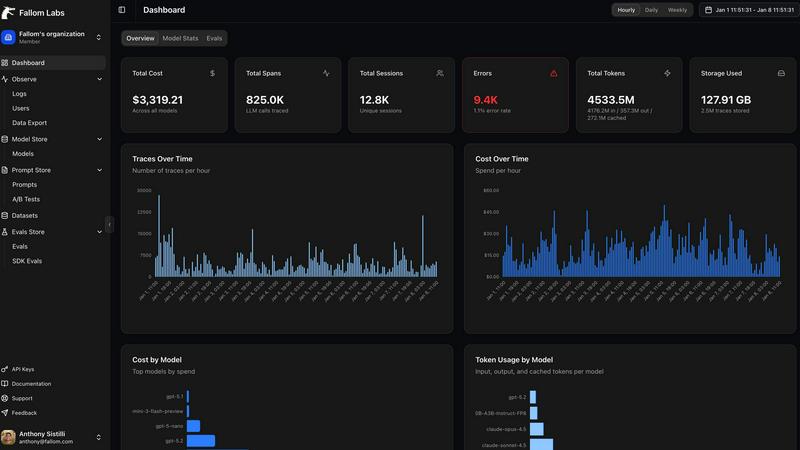
Fallom is the definitive AI-native observability platform, engineered for the complex, multi-step realities of production LLM and autonomous agent workloads. It represents a paradigm shift from fragmented monitoring to holistic, end-to-end intelligence. In an era where AI operations are critical infrastructure, Fallom provides the mission-critical visibility needed to build, deploy, and scale AI applications with confidence and control. It is built for engineering teams, product leaders, and compliance officers who demand more than just metrics—they require a deep, contextual understanding of every AI interaction. The platform's core value proposition is delivering complete operational transparency: seeing every LLM call, tool invocation, and agentic step in real-time, with granular data on prompts, outputs, tokens, latency, and cost. By unifying this telemetry with session-level context and enterprise-grade audit trails, Fallom transforms opaque AI operations into a debuggable, optimizable, and governable system. With its OpenTelemetry-native foundation, it ensures vendor-agnostic instrumentation in minutes, breaking down silos and providing a single source of truth for AI performance, spend, and compliance across all models and providers.
Features of Fallom
Real-Time LLM & Agent Tracing
Gain complete, real-time visibility into every interaction within your AI stack. Fallom captures and displays every LLM call, tool invocation, and reasoning step in a unified trace, providing granular data on inputs, outputs, token usage, latency, and cost. This enables instantaneous debugging of complex, multi-step agent workflows, allowing you to pinpoint failures, understand decision paths, and optimize performance with surgical precision.
Enterprise Cost Attribution & Governance
Achieve full financial transparency and control over your AI spend. Fallom automatically attributes costs down to the model, team, user, or customer level, enabling precise budgeting and chargebacks. Coupled with comprehensive audit trails, input/output logging, and model versioning, it provides the foundational data layer needed for compliance with stringent regulations like the EU AI Act, SOC 2, and GDPR.
Advanced Analytics & Model Operations
Move beyond basic metrics with powerful analytics built for AI. Conduct robust model A/B testing with live traffic splitting, run automated evaluations for accuracy and hallucinations, and version-control your prompts in a centralized Prompt Store. These capabilities allow you to scientifically improve quality, roll out new models confidently, and catch regressions before they impact users.
Privacy-First Architecture & Session Intelligence
Maintain full observability while protecting sensitive data. Fallom's Privacy Mode allows you to disable content capture or redact specific fields, ensuring compliance without sacrificing telemetry. Simultaneously, its session-tracking capability groups all traces by user, customer, or conversation, providing the holistic context needed to understand complete customer journeys and troubleshoot complex issues.
Use Cases of Fallom
Scaling Production AI Agents
Engineering teams use Fallom to transition AI prototypes into reliable, scalable production systems. By providing a real-time waterfall view of multi-step agentic workflows—including LLM calls, database queries, and API tool usage—teams can debug complex failures, optimize latency bottlenecks, and ensure their autonomous agents operate reliably at scale, delivering consistent user experiences.
Ensuring Regulatory Compliance & Auditability
Compliance officers and security teams leverage Fallom to meet rigorous regulatory requirements for AI systems. The platform generates immutable, detailed audit trails of every LLM interaction, including full prompt/response history, model versions, and user identifiers. This creates a verifiable chain of custody essential for audits, liability assessments, and adherence to frameworks like the EU AI Act.
Optimizing AI Spend & ROI
Product and finance leaders utilize Fallom's granular cost attribution to demystify AI expenditure. By tracking spend per project, feature, team, or end-customer, organizations can identify waste, justify budgets, implement chargebacks, and calculate precise ROI. This financial clarity is critical for managing AI as a scalable business utility rather than a black-box cost center.
Driving AI Product Excellence
Product managers employ Fallom's analytics suite to quantitatively improve AI features. They run A/B tests on different models or prompt versions, monitor evaluation scores for quality metrics like relevance and accuracy, and analyze user session traces to understand interaction patterns. This data-driven approach enables continuous iteration and delivery of superior AI-powered product experiences.
Frequently Asked Questions
How does Fallom instrument my AI application?
Fallom is built natively on OpenTelemetry (OTEL), the open-source standard for observability. You integrate a single, lightweight SDK that automatically instruments calls to all major LLM providers (OpenAI, Anthropic, Google, etc.) and custom tool/function calls. This vendor-agnostic approach provides complete tracing in under 5 minutes with zero lock-in, creating a unified telemetry pipeline.
Can Fallom handle sensitive or private data?
Absolutely. Fallom is designed with enterprise-grade privacy controls. You can enable Privacy Mode to run with metadata-only logging, redact specific data fields, or disable content capture entirely for sensitive environments. This allows you to maintain full operational and performance observability while ensuring user data and intellectual property remain protected and compliant.
What makes Fallom different from traditional APM tools?
Traditional Application Performance Monitoring (APM) tools are built for conventional software, not the unique, non-deterministic nature of AI. Fallom is AI-native, understanding core concepts like prompts, tokens, LLM calls, agentic reasoning, and model costs. It provides the specific context, traces, and analytics needed to debug hallucinations, optimize token usage, and govern multi-step AI workflows, which generic APM cannot.
Does Fallom support testing and evaluation of LLM outputs?
Yes. Fallom includes a robust evaluation and testing framework. You can define custom evaluation criteria (e.g., accuracy, safety, hallucination rate) and run them automatically on production traces or staged deployments. This allows you to catch quality regressions, compare the performance of different model versions scientifically, and ensure only high-quality AI responses reach your end-users.
Explore more in this category:
Similar to Fallom

Sprite Sheet Maker
A free browser-based toolkit for creating, cutting, converting, and previewing sprite sheet animations.

tallycounterweb.com
Online tally counter for tracking attendance, workouts, inventory, sports scores, visitors, habits, and everyday counting tasks.


Forms Plugin
The #1 Native Form Builder Plugin for Framer - No Code, No Embeds, No External Platforms.


TryKlingAI
Create Kling AI videos from text, images, audio, and motion references with Kling 3.0, Motion Control, Lip Sync, task tracking, and API access.