
Fallom vs qtrl.ai
Side-by-side comparison to help you choose the right AI tool.

Fallom delivers real-time AI observability for every LLM call and agent.
Last updated: February 28, 2026

qtrl.ai
Revolutionize your QA process with qtrl.ai, the AI-powered platform that scales testing while ensuring control and.
Last updated: March 4, 2026
Visual Comparison
Fallom
qtrl.ai
Feature Comparison
Fallom
Real-Time LLM & Agent Tracing
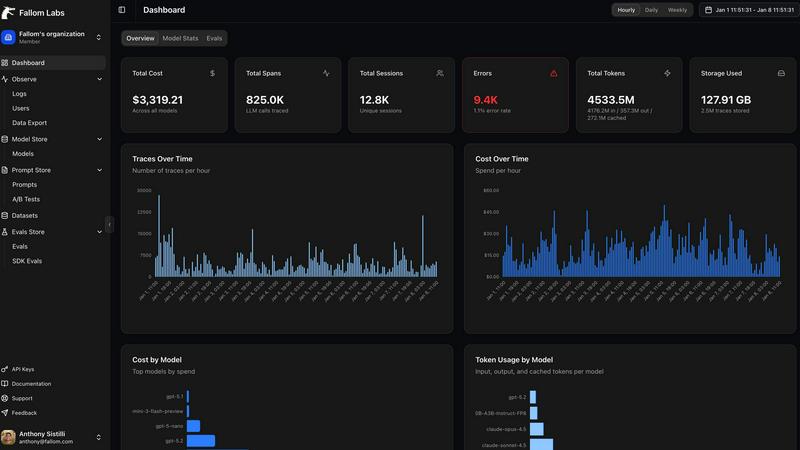
Gain complete, real-time visibility into every interaction within your AI stack. Fallom captures and displays every LLM call, tool invocation, and reasoning step in a unified trace, providing granular data on inputs, outputs, token usage, latency, and cost. This enables instantaneous debugging of complex, multi-step agent workflows, allowing you to pinpoint failures, understand decision paths, and optimize performance with surgical precision.
Enterprise Cost Attribution & Governance
Achieve full financial transparency and control over your AI spend. Fallom automatically attributes costs down to the model, team, user, or customer level, enabling precise budgeting and chargebacks. Coupled with comprehensive audit trails, input/output logging, and model versioning, it provides the foundational data layer needed for compliance with stringent regulations like the EU AI Act, SOC 2, and GDPR.
Advanced Analytics & Model Operations
Move beyond basic metrics with powerful analytics built for AI. Conduct robust model A/B testing with live traffic splitting, run automated evaluations for accuracy and hallucinations, and version-control your prompts in a centralized Prompt Store. These capabilities allow you to scientifically improve quality, roll out new models confidently, and catch regressions before they impact users.
Privacy-First Architecture & Session Intelligence
Maintain full observability while protecting sensitive data. Fallom's Privacy Mode allows you to disable content capture or redact specific fields, ensuring compliance without sacrificing telemetry. Simultaneously, its session-tracking capability groups all traces by user, customer, or conversation, providing the holistic context needed to understand complete customer journeys and troubleshoot complex issues.
qtrl.ai
Autonomous QA Agents
qtrl.ai's Autonomous QA Agents execute instructions on demand or continuously, offering unparalleled scalability across various environments. They operate strictly within the defined governance rules, ensuring real browser execution rather than relying on simulations, which enhances the reliability of test outcomes.
Enterprise-Grade Test Management
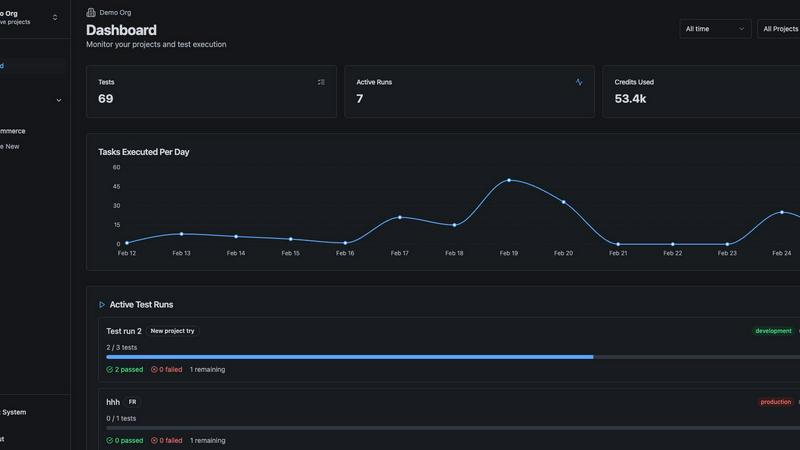
The platform provides a centralized method for managing test cases, plans, and runs, ensuring full traceability and comprehensive audit trails. This feature supports both manual and automated workflows, facilitating compliance and auditability, which is essential for organizations that prioritize governance.
Progressive Automation
With qtrl.ai, teams can initiate their QA processes with human-written instructions and gradually advance to AI-generated tests. The platform intelligently suggests new tests based on coverage gaps, allowing teams to review, approve, and refine test scenarios at every step, ensuring quality remains paramount.
Adaptive Memory
qtrl.ai boasts an Adaptive Memory feature that builds a living knowledge base of the application. It learns from test execution, exploration, and issues, enabling smarter, context-aware test generation that becomes increasingly effective with each interaction, significantly boosting testing efficiency over time.
Use Cases
Fallom
Scaling Production AI Agents
Engineering teams use Fallom to transition AI prototypes into reliable, scalable production systems. By providing a real-time waterfall view of multi-step agentic workflows—including LLM calls, database queries, and API tool usage—teams can debug complex failures, optimize latency bottlenecks, and ensure their autonomous agents operate reliably at scale, delivering consistent user experiences.
Ensuring Regulatory Compliance & Auditability
Compliance officers and security teams leverage Fallom to meet rigorous regulatory requirements for AI systems. The platform generates immutable, detailed audit trails of every LLM interaction, including full prompt/response history, model versions, and user identifiers. This creates a verifiable chain of custody essential for audits, liability assessments, and adherence to frameworks like the EU AI Act.
Optimizing AI Spend & ROI
Product and finance leaders utilize Fallom's granular cost attribution to demystify AI expenditure. By tracking spend per project, feature, team, or end-customer, organizations can identify waste, justify budgets, implement chargebacks, and calculate precise ROI. This financial clarity is critical for managing AI as a scalable business utility rather than a black-box cost center.
Driving AI Product Excellence
Product managers employ Fallom's analytics suite to quantitatively improve AI features. They run A/B tests on different models or prompt versions, monitor evaluation scores for quality metrics like relevance and accuracy, and analyze user session traces to understand interaction patterns. This data-driven approach enables continuous iteration and delivery of superior AI-powered product experiences.
qtrl.ai
Product-Led Engineering Teams
For product-led engineering teams, qtrl.ai streamlines the quality assurance process by integrating testing directly within the development workflow. This ensures that product features are rigorously tested, facilitating faster releases while maintaining high standards of quality.
QA Teams Scaling Beyond Manual Testing
As QA teams outgrow manual testing methods, qtrl.ai provides the tools necessary to scale operations efficiently. The platform's automation capabilities allow teams to transition smoothly from manual processes to intelligent automation, increasing productivity and reducing time to market.
Companies Modernizing Legacy QA Workflows
Organizations looking to modernize outdated QA workflows can leverage qtrl.ai to revamp their testing strategies. By incorporating advanced test management and AI automation, companies can enhance their testing efficacy, reduce costs, and ensure compliance with modern standards.
Enterprises Requiring Governance and Traceability
For enterprises that mandate strict governance and traceability, qtrl.ai delivers a robust solution that provides comprehensive visibility into testing processes. With features designed for compliance, organizations can ensure that every step of the QA process is documented and accountable.
Overview
About Fallom
Fallom is the definitive AI-native observability platform, engineered for the complex, multi-step realities of production LLM and autonomous agent workloads. It represents a paradigm shift from fragmented monitoring to holistic, end-to-end intelligence. In an era where AI operations are critical infrastructure, Fallom provides the mission-critical visibility needed to build, deploy, and scale AI applications with confidence and control. It is built for engineering teams, product leaders, and compliance officers who demand more than just metrics—they require a deep, contextual understanding of every AI interaction. The platform's core value proposition is delivering complete operational transparency: seeing every LLM call, tool invocation, and agentic step in real-time, with granular data on prompts, outputs, tokens, latency, and cost. By unifying this telemetry with session-level context and enterprise-grade audit trails, Fallom transforms opaque AI operations into a debuggable, optimizable, and governable system. With its OpenTelemetry-native foundation, it ensures vendor-agnostic instrumentation in minutes, breaking down silos and providing a single source of truth for AI performance, spend, and compliance across all models and providers.
About qtrl.ai
qtrl.ai is a cutting-edge quality assurance platform engineered for modern software teams seeking to enhance their QA processes without relinquishing governance or oversight. By seamlessly integrating enterprise-grade test management with advanced AI automation, qtrl.ai creates a centralized hub that empowers teams to organize their test cases, plan test runs, and trace requirements back to coverage. This structured foundation is crucial for tracking quality metrics through real-time dashboards, providing visibility into testing progress, pass rates, and potential risks, which is indispensable for engineering leads and QA managers. What sets qtrl.ai apart is its innovative AI layer that introduces intelligent automation gradually, allowing teams to begin with manual test management before transitioning to fully autonomous agents. These agents can generate UI tests from natural language descriptions, adapt them as applications evolve, and execute tests at scale across diverse browsers and environments. qtrl.ai is ideal for product-led engineering teams, QA groups transitioning from manual testing, organizations modernizing legacy workflows, and enterprises requiring stringent compliance. Ultimately, qtrl.ai bridges the gap between the slow pace of manual testing and the complexities of traditional automation, paving the way for a faster, more intelligent approach to quality assurance.
Frequently Asked Questions
Fallom FAQ
How does Fallom instrument my AI application?
Fallom is built natively on OpenTelemetry (OTEL), the open-source standard for observability. You integrate a single, lightweight SDK that automatically instruments calls to all major LLM providers (OpenAI, Anthropic, Google, etc.) and custom tool/function calls. This vendor-agnostic approach provides complete tracing in under 5 minutes with zero lock-in, creating a unified telemetry pipeline.
Can Fallom handle sensitive or private data?
Absolutely. Fallom is designed with enterprise-grade privacy controls. You can enable Privacy Mode to run with metadata-only logging, redact specific data fields, or disable content capture entirely for sensitive environments. This allows you to maintain full operational and performance observability while ensuring user data and intellectual property remain protected and compliant.
What makes Fallom different from traditional APM tools?
Traditional Application Performance Monitoring (APM) tools are built for conventional software, not the unique, non-deterministic nature of AI. Fallom is AI-native, understanding core concepts like prompts, tokens, LLM calls, agentic reasoning, and model costs. It provides the specific context, traces, and analytics needed to debug hallucinations, optimize token usage, and govern multi-step AI workflows, which generic APM cannot.
Does Fallom support testing and evaluation of LLM outputs?
Yes. Fallom includes a robust evaluation and testing framework. You can define custom evaluation criteria (e.g., accuracy, safety, hallucination rate) and run them automatically on production traces or staged deployments. This allows you to catch quality regressions, compare the performance of different model versions scientifically, and ensure only high-quality AI responses reach your end-users.
qtrl.ai FAQ
What makes qtrl.ai different from traditional QA platforms?
qtrl.ai differentiates itself by combining enterprise-grade test management with progressive AI automation, allowing teams to scale their quality assurance efforts without sacrificing oversight or control.
Can qtrl.ai integrate with existing tools?
Yes, qtrl.ai is designed to seamlessly integrate with your existing tools and workflows, ensuring a smooth transition and enhanced collaboration across your development and QA teams.
How does the Adaptive Memory feature work?
The Adaptive Memory feature builds a living knowledge base of your application by learning from exploration, test execution, and issues. This enables qtrl.ai to generate smarter, context-aware tests that improve over time.
Is qtrl.ai suitable for small teams?
Absolutely! qtrl.ai is designed to scale with your team, making it suitable for small teams looking to enhance their QA processes as well as larger enterprises requiring comprehensive governance and compliance features.
Alternatives
Fallom Alternatives
Fallom is the definitive AI-native observability platform, engineered for the complex realities of production LLM and agent workloads. It delivers mission-critical visibility, transforming opaque AI operations into a debuggable and governable system with complete operational transparency. Users may explore alternatives for various reasons, including specific budget constraints, a need for different feature integrations, or platform requirements that prioritize a narrower scope of monitoring. The search for a different solution is a natural part of architecting a resilient AI stack. When evaluating any observability tool, key considerations should include the depth of trace granularity for multi-step agents, the robustness of compliance and audit capabilities, and the ease of vendor-agnostic instrumentation. The goal is to achieve holistic intelligence, not just fragmented metrics.
qtrl.ai Alternatives
qtrl.ai is a cutting-edge quality assurance platform that empowers software teams to elevate their testing processes through intelligent automation while maintaining stringent control and governance. As part of the automation and Dev tools landscape, qtrl.ai integrates advanced AI capabilities with robust test management features, creating a centralized hub for organizing test cases, planning test runs, and tracking quality metrics in real-time. Users often seek alternatives to qtrl.ai due to various factors such as pricing structures, specific feature sets, and unique platform requirements that may not be addressed by qtrl.ai. When considering alternatives, it’s essential to evaluate the scalability of the solution, the ease of integration with existing workflows, the flexibility of automation options, and the level of support offered to ensure it aligns with your team’s quality assurance goals.